Leg Ulcers
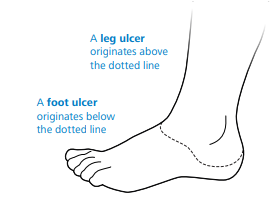
A leg ulcer is defined by the National Wound Care Strategy as ‘an ulcer that originates on or above the malleolus but below the knee that takes more than 2 weeks to heal’.
There are several reasons why people get leg ulcers, the most common one (approx. 60 – 80%) being due to venous insufficiency arising from faulty valves in the veins and/ or poor calf muscle pump action.
A smaller percentage of ulcers (10 – 20%) are caused by poor circulation in the arteries or as a result of other diseases such as diabetes or rheumatoid arthritis.
Treatment
It is estimated that approximately 1.5% of the adult population in the UK is affected by active leg and foot ulceration, which equates to 730,000 patients (Guest 2019).
Without correct treatment, ulcers can remain unhealed for many months or sometimes years, resulting in episodes of infection, pain and immobility. The biggest proportion of leg ulceration is due to venous insufficiency.
However, many ulcers do have a mixed aetiology with elements of arterial disease or chronic oedema which may be further complicated by heart failure.
The Lower Limb Care Pathway
The Lower Limb Care pathway is available here Resources – Tissue Viability.
This pathway encompasses all aspects of lower limb care, in line with the NWCSP-Leg-Ulcer-Recommendations-v2-1.8.2023 and the Wounds UK Best Practice Statement – The Use of Compression Therapy for peripheral oedema: Considerations in people with Heart Failure (2023)
All clinicians delivering leg ulcer care are expected to use this pathway.
Chronic Oedema

Chronic Oedema
Chronic oedema is persistent swelling that has been present for three months or more. It most commonly affects the limbs but can also occur in the trunk, head and neck, or genital area.
Chronic oedema can have many different causes, including:
- Dependent oedema – often associated with reduced mobility
- Venous oedema – associated with chronic venous disease, such as severe varicose veins or post-thrombotic syndrome
- Obesity-associated oedema
- Lymphoedema – primary or secondary
- Oedema associated with advanced cancer
- Oedema associated with heart failure
Why does chronic oedema matter?
Chronic oedema is not just swelling. Without appropriate management, persistent oedema can progressively change the tissues and skin, increasing the risk of complications.
Over time, the skin may become:
- Discoloured
- Dry and scaly
- Inflamed or eczematous
- Thickened or hardened
The tissues become increasingly vulnerable to injury, and the risk of developing leg ulceration and infection increases. Wounds may also be more difficult to heal.
As chronic oedema progresses, the limb can become increasingly enlarged and distorted, with deep skin folds and a characteristic cobblestone appearance. In advanced cases, fluid can leak through the skin (lymphorrhoea or “leaky legs”), sometimes in large volumes.
See the CHROSS Checker picture cards below for examples of the skin and tissue changes associated with chronic oedema.
The importance of early intervention
Chronic oedema can have a significant impact on a person’s mobility, independence, wellbeing and quality of life. It also places a considerable demand on health services through increased wound care, treatment of infection, staff time and healthcare resources.
Early recognition and intervention are key to preventing progression and reducing complications.
Management should be tailored to the individual and may include:
- Compression therapy – where clinically appropriate
- Skin care – to maintain skin integrity and reduce the risk of infection
- Exercise and movement – to support lymphatic and venous return
- Elevation – where appropriate, to help manage swelling
- Wound management – where ulceration is present
- Management of the underlying cause
Chronic oedema can be challenging to manage, particularly when complicated by ulceration, lymphorrhoea or recurrent infection. However, early assessment and a consistent, holistic management approach can help reduce these complications and prevent further deterioration.
Appropriate compression is often a key component of management, but the type and level of compression must be determined by clinical assessment and the underlying cause of the oedema.
Compression therapy

Compression Therapy
Correctly selected and applied compression therapy is a cornerstone of the prevention and treatment of venous disease and chronic lower limb oedema. It also remains a key treatment for venous leg ulceration where compression is clinically appropriate.
Compression therapy can be delivered through compression bandaging, hosiery or adjustable compression systems. The choice of compression should be guided by a holistic assessment of the patient, their limb, wound characteristics, vascular status, mobility, dexterity, tolerance and ability to self-care.
How does compression therapy work?
Compression therapy helps the veins in the leg move blood back towards the heart. It does this by:
- Supporting venous return – helps blood flow more efficiently through the deeper veins.
- Reducing venous pressure – reduces the size of superficial veins and the pressure within them.
- Reducing swelling (oedema) – helps move excess fluid out of the tissues
- Supporting healthier skin – helps manage the skin changes associated with chronic venous disease and creates better conditions for wound healing.
In simple terms:
Compression helps counteract the effects of venous hypertension, reducing swelling and supporting blood flow back up the leg.
Assess before applying compression
Compression should always be selected according to clinical assessment.
Where there are no red flags for compression, reduced/mild compression can be used as part of immediate and necessary care while arrangements are made for a comprehensive assessment.
Strong compression should not be applied until the arterial status of the limb has been established. A holistic vascular assessment, including ABPI where clinically indicated, should be completed before initiating strong compression. Findings should be interpreted alongside the wider clinical assessment and in line with local policy and guidance.
For further information, please refer to the Lower Limb Care Pathway.
Choosing the right compression system
There is no single compression system that is suitable for every patient. The patient’s clinical presentation, assessment, needs & preferences should all be considered to determine the most appropriate option.
Two-layer compression hosiery kits
Two-layer hosiery kits may be an appropriate first-line option for patients with minimal oedema, a regular limb shape and (if present) a wound that can be contained within an appropriate adhesive dressing (refer to wound care formulary).
Our formulary product changed in 2024 from ActiLymph to JOBST UlcerCare.
The two components provide a progressive compression system:
- JOBST UlcerCare Liner – provides up to 20mmHg compression and can be used where mild compression is appropriate, including as part of immediate and necessary care following assessment and exclusion of relevant red flags.
- JOBST UlcerCare Outer Stocking – when applied over the liner, the complete two-layer system provides a up to 40mmHg compression at the ankle, supporting the treatment of venous leg ulceration where strong compression is clinically appropriate.
Hosiery kits can offer a number of benefits for patients, including being less bulky than some bandaging systems and supporting independence and self-management. Evidence also indicates that compression hosiery can be a cost-effective alternative to compression bandaging for appropriately selected patients.
Hosiery kits are not suitable for everyone.
Patients with significant or fluctuating oedema, a distorted or irregular limb shape, very large wounds, or heavily exuding wounds may be better suited to compression bandaging or another compression system. Please refer to the Jobst Ulcer Care Kit final checklist before applying to your patient.
A bitesize training session on selecting the right compression for your patient cant be found here:
JOBST UlcerCare: JOBST UlcerCare Compression Garments – JOBST UK
Multi-layer compression bandaging
Multi-layer compression bandaging systems, such as K-Two kits, provide an alternative where hosiery is not appropriate.
They may be particularly useful for patients with:
- Mild to moderate oedema
- Larger wounds
- Heavily exuding wounds
- Limb shape or size that makes hosiery unsuitable
Short-stretch compression bandaging
Patients with moderate-severe oedema and/or a distorted limb shape may benefit from short-stretch compression bandaging, such as Clinistretch.
Short-stretch systems can accommodate changes in limb contour and provide effective containment of oedema. They can also be particularly useful for more active patients because they generate increased working pressure during movement while maintaining comparatively lower resting pressure.
For application guidance and demonstration videos, please see:
Clinistretch Compression Bandaging Guides on Vimeo
Adjustable compression wraps
Adjustable compression wrap systems may also have a role in compression management. They can be particularly useful where traditional bandaging or hosiery is not tolerated, is difficult to apply, or is impractical, and may support patient independence and self-management.
Their role should be considered on an individual basis and in line with local guidance, particularly during active wound healing. They may also be useful following ulcer healing for ongoing management of oedema and prevention of recurrence.
Compression after wound healing
Once a venous leg ulcer has healed, ongoing compression is important to help manage chronic venous disease and reduce the risk of recurrence.
The most appropriate compression garment or wrap should be selected according to the patient’s clinical assessment, limb shape, oedema, mobility, dexterity and ability to apply and tolerate the garment.
For guidance on the selection and application of compression hosiery in Oxfordshire, please refer to:
- Oxfordshire Compression Hosiery booklet
- Oxfordshire Compression Hosiery and Wrap Formulary
- CHROSS checker tool- A4 form
- CHROSS checker tool – picture cards
- Hosiery prescription guidance V2
These resources provide further information to support appropriate assessment, selection, prescribing and application of compression hosiery.
Key message: The right compression for the right patient at the right time.
Compression should be selected following appropriate assessment, with the patient’s vascular status, oedema, limb shape, wound characteristics, preferences and ability to manage the chosen system all taken into consideration.
